The first AI concept arrived in under a minute. It had the right mood, a strong colour direction and one obvious problem: the product surface was physically impossible.
A raw generation might have survived a casual Instagram scroll. It could not represent a real client product.
So we kept the direction, rebuilt the composition, corrected the material, set the typography in a proper design tool, prepared platform crops and reviewed the final asset with the client. The useful speed came from finding the idea early. The quality came from finishing it properly.
AI social media creative services in India should work this way: fast visual exploration first, human art direction and post-production next, then distribution tied to a measurable lead path. Publishing raw generations because they are cheap is not a strategy.
Key takeaways
- AI is strongest at exploration and variation, not unsupervised final production.
- Brand assets and product facts must anchor every prompt and review.
- Instagram, LinkedIn, Meta Ads, Google Business Profile and Bing serve different buyer moments.
- Organic content can warm a lead; paid media and outreach still need targeting and follow-up.
- Measure qualified actions and CRM progress rather than counting output volume.
Why ideas need to move faster
Traditional creative production often begins too late in the decision process.
A team writes a detailed brief, waits for a shoot, reviews one direction and discovers after two weeks that the visual idea does not work in a mobile feed. Because the production cost is already committed, everyone tries to rescue it.
AI changes the order. A designer can explore lighting, setting, composition, colour and campaign mood before a location is booked or a full 3D scene is rendered. Twenty rough directions can expose what the team dislikes as quickly as what it likes.
That does not mean twenty posts should be published.
The production advantage is the ability to discard weak ideas cheaply. The best two or three directions move into normal design work. The rest have done their job.
This matters for fast-moving businesses because feeds change, offers change and paid campaigns need fresh variations. Waiting six weeks for every concept creates a bottleneck. Publishing six weeks of mediocre AI images creates a reputation problem.
The sensible middle is a faster editorial room with a stricter final gate.
This is also why creative and marketing agencies hire NodeAscend. They can lead the brand or media relationship while our team supplies AI concept development, technical production, campaign assets, landing pages and the automation needed to move qualified enquiries into a CRM.
Our AI social media creative services workflow
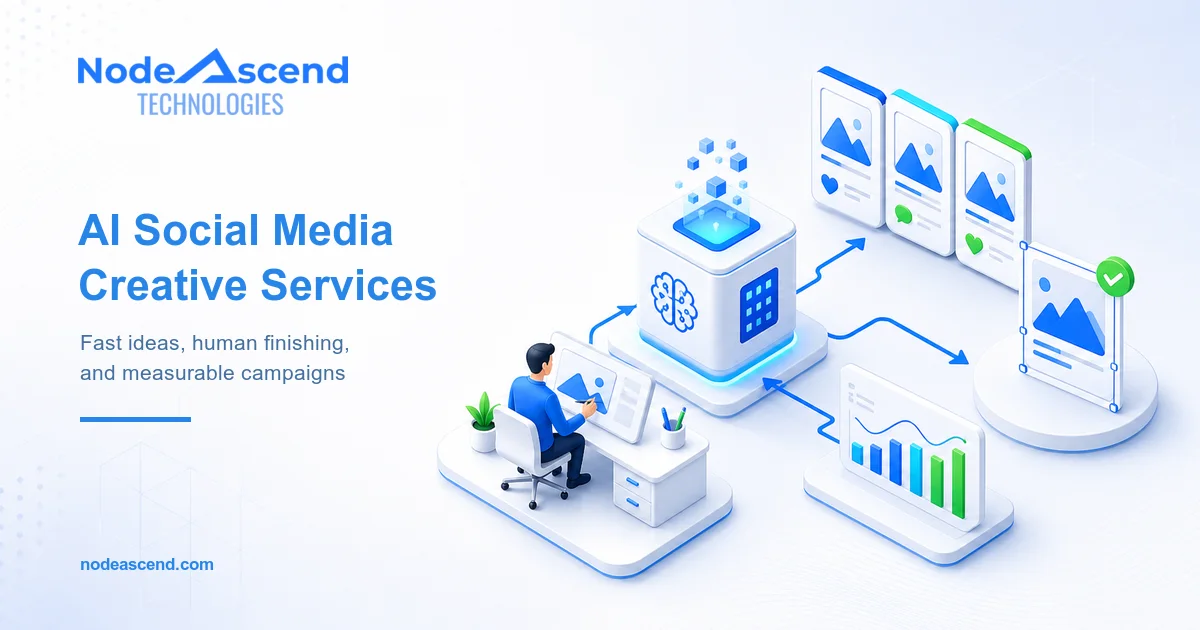
We use a six-stage process for social media and campaign creative.
| Stage | Output | Human decision |
|---|---|---|
| Business brief | Audience, offer, channel and desired action | Is the campaign worth making? |
| Visual direction | References, palette, framing and constraints | Does this feel like the brand? |
| AI exploration | Multiple rough concepts and compositions | Which ideas deserve production? |
| Post-production | Corrected imagery, typography, layout and crops | Is every visible claim accurate? |
| Channel adaptation | Feed, story, reel cover, document and ad variants | Does each format have one job? |
| Measurement | Campaign IDs, landing paths and CRM outcomes | What should change next? |
The brief comes before the prompt
A prompt cannot compensate for a missing commercial decision.
Before generating anything, we define who should notice the post, what they should understand and what they can do next. A LinkedIn document for operations leaders needs a different idea from an Instagram reel cover for interior designers.
We also record invariants: logo treatment, product geometry, colours, claims, people, locations and cultural details that must not drift.
AI produces options, not authority
Generation is useful for environments, scene directions, layout exploration, mood and variations. It is less reliable for exact product structure, readable packaging, logos, small text, hands and anything whose physical construction matters.
The designer reviews at full size, not only as a thumbnail. Bad anatomy, repeated details, misleading materials and invented text are removed before a client sees the option.
Traditional tools finish the asset
Selected directions move into Figma, Photoshop, Illustrator, After Effects, Blender or the client’s existing production stack. Typography is typeset rather than generated inside an image. Product photography is composited carefully. Colour is aligned to the brand system. Motion is edited for the platform and captions are checked against the actual offer.
That handoff is the difference between AI creation and AI-assisted production.
Aurum: translating a brand into a social system
Aurum Wall Decor began with a material that needed explanation: ultra-thin natural stone surfaces that can curve and wrap around forms. NodeAscend developed the brand and website around a warm editorial idea rather than the usual black-and-gold version of luxury.
The social system had to preserve the same restraint.
For the public Aurum Instagram account, useful content directions include material close-ups, installation context, collection stories, architect-facing applications and short explanations of what makes flexible stone different. AI can help test rooms, lighting and scene composition. The actual product needs approved source photography or an accurate 3D model.
The post-production rules are simple:
- cream, stone, forest and restrained gold remain the visual base;
- typography follows the brand rather than whatever the generator invents;
- surfaces cannot gain false veining, thickness or flexibility;
- every installation claim must be technically accurate;
- posts should create interest in a collection or sample, not only look expensive.
We will not attach follower growth, lead volume or engagement claims to this case without approved account data. The visible proof is the coherence between the website, identity and social direction.
That is enough to make a useful point: AI can expand a brand system quickly when the system already exists. It cannot substitute for one.
Give each channel one clear job
“Post everywhere” is usually a sign that nobody has chosen an audience.
Instagram and Meta
Instagram is a visual discovery and trust channel for categories such as interiors, hospitality, wellness, food, retail and local consumer services. Organic content demonstrates taste and consistency. Meta Ads can take the strongest offer or creative direction to a defined audience and connect it to a landing page, lead form, WhatsApp conversation or retargeting sequence.
The content calendar and the media plan should talk to each other. A post that earns useful saves, profile visits or enquiries may deserve paid testing. A beautiful post that attracts only other designers may be doing the wrong job.
For B2B services, software, manufacturing and technical founders, LinkedIn often needs fewer polished posters and more visible thinking. Founder observations, project decisions, documents, diagrams and credible proof build familiarity before a sales conversation.
LinkedIn’s advertising products can target professional attributes such as company or job role, subject to the platform’s rules and the market. LinkedIn explains its Marketing Solutions targeting and formats.
Cold outreach can remain part of the system, but mass-produced AI messages are a fast way to damage the account and the brand. Outreach should be narrow, researched and connected to something useful the recipient can inspect.
Google Business Profile and Bing
Google Business Profile posts can share updates, offers and events on Search and Maps. Google’s Business Profile guidance describes where those updates can appear and how older posts are handled.
For a local business, this channel catches people already showing geographic intent. Project images, service explanations, approved offers and operational updates are usually more helpful than generic festival graphics.
Bing Places and Microsoft Advertising deserve consideration when the audience uses Windows-heavy corporate environments or search data shows demand. They should be measured like any other channel, not added to a package because another logo looks impressive.
Social media can qualify leads before outreach
A buyer rarely experiences marketing as separate departments.
They may see a LinkedIn post, visit the website a week later, search the company name, read a Google review and finally reply to an email. Social media’s job is often to make that later conversation warmer and more informed.
Qualified lead generation needs the pieces to connect:
- Content addresses a recognisable problem for a defined buyer.
- Distribution reaches that buyer organically or through paid targeting.
- The next step matches their level of intent.
- The landing page continues the same promise.
- Source and campaign data reach the CRM.
- Sales follows up with the context intact.
This is stronger than claiming social media “replaces cold outreach.” It can reduce dependence on blind outreach and give prospects something credible to evaluate. A focused outbound message may still introduce the right person to that evidence.
At NodeAscend, social management can connect with landing pages, Meta campaigns, LinkedIn campaigns, Google Business Profile, Bing listings, CRM routing and performance marketing. The channel plan depends on where the buyer actually makes decisions.
Measure business movement, not creative volume
AI makes it easy to count the wrong thing.
One hundred generated images are not one hundred pieces of value. Even reach and engagement can be misleading when the audience is wrong.
We organise reporting around a small ladder:
| Layer | Useful questions |
|---|---|
| Creative | Which hook, format and visual direction earned attention? |
| Audience | Did the intended roles, locations or customer groups respond? |
| Traffic | Did people reach the right landing page and stay? |
| Lead | Did they submit, call, message or book? |
| Quality | Did the enquiry match the service and budget? |
| Revenue | Did the lead progress through the CRM? |
Creative iteration then has a reason. We change the opening frame because the right audience is not stopping, or the call to action because interested visitors are not taking the next step. We do not change colours every week to make the calendar look busy.
An AI creative production partner for other agencies
Brand studios, social media teams and performance agencies do not always need another generalist. They need a production partner that can move between AI generation, traditional post-production, web delivery and campaign technology without losing the original creative direction.
NodeAscend supports agency teams with AI concept exploration, image and video post-production, platform adaptations, LinkedIn and Meta campaign assets, landing pages, conversion tracking, Google Business Profile content and CRM routing. We can work white-label, collaborate with the agency’s designers or take ownership of a defined production stream.
The advantage is continuity. The creative does not end as a folder of posts; it can continue into the responsive website, ad experience, lead form, automation and reporting system that makes the campaign commercially useful.
The human finish is the service
Ideas will keep getting cheaper. Judgement will not.
The valuable team is the one that can decide what should be made, recognise when an AI output is wrong, finish the chosen direction and connect it to a commercial system. It can also tell a client when a real photographer, illustrator, editor or on-location shoot is the better tool.
NodeAscend combines AI creative production, social media management, campaign execution and the web/CRM work needed after somebody clicks.
If your content operation is too slow, or fast but forgettable, ask us to review the creative-to-lead workflow.
Frequently Asked Questions
Does NodeAscend publish raw AI-generated images?
No. AI outputs are concept material. Selected directions move through composition, retouching, typography, brand, factual and platform checks in traditional production tools before approval. Raw generations may contain visual errors or fail to represent the product accurately.
Can AI social media content generate qualified leads?
It can support qualified lead generation when the content speaks to a defined buyer, reaches that audience through the right organic or paid channel and connects to a tracked next step. AI production speed alone does not create demand or lead quality.
Which platforms does NodeAscend manage?
Depending on the audience, NodeAscend can plan and manage Instagram, Facebook and Meta campaigns, LinkedIn content and ads, Google Business Profile updates, Bing listings and Microsoft Advertising. Channel scope follows the buyer journey rather than a standard package.
Does AI replace photographers, designers and editors?
No. It changes when each skill is used. AI can accelerate visual exploration and variation, while photographers capture evidence, designers build the system and editors produce accurate final assets. Product truth, brand judgement and approval remain human responsibilities.
Can you use our existing brand assets and product photographs?
Yes. Existing photography, packaging, fonts, colour rules and approved references should anchor the workflow. The team should also define which elements AI may transform and which product details must remain exact.