Apps That Work on One Bar and 6% Battery
Production mobile applications that handle spotty 3G connections, low-memory devices, and the thousand edge cases that only show up when real users start using your app.
What you get, and what changes
A NodeAscend app is the version of your service that still works on one bar of signal and 6% battery. One codebase serves iOS and Android, which keeps the cost of every future feature roughly halved and stops the two platforms drifting into different products. We handle the parts that sink most app projects: store submission and review, push notifications that actually arrive, offline behaviour that syncs cleanly when the connection returns, and crash reporting that tells you what broke rather than that something did. Support carries on past launch, because month nine is when apps come apart — an OS update, a store policy change, or a backend that has outgrown its first design.
Our Mobile App Development Services
Swift-based apps optimized for Apple's ecosystem
iPhone and iPad applications that follow Apple's Human Interface Guidelines, perform smoothly on the latest iOS versions, and pass App Store review on the first submission. From simple utility apps to complex enterprise applications with offline capabilities and Apple Pay integration.
Kotlin apps for thousands of device configurations
Kotlin-based Android applications following Material Design 3 guidelines. We build apps that handle Android's device fragmentation gracefully: adaptive layouts, backward compatibility, efficient memory management, and battery optimization.
One codebase, native performance on both platforms
React Native and Flutter let us share 70-90% of code across platforms while maintaining native performance. We choose the right framework based on your needs: React Native for JavaScript teams, Flutter for pixel-perfect custom UI.
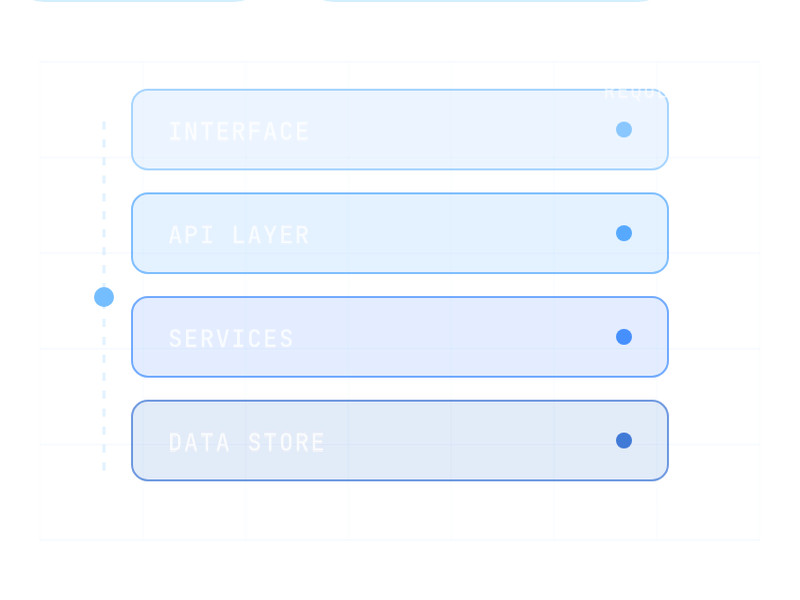
APIs and cloud infrastructure that scale
Robust server infrastructure: RESTful and GraphQL APIs, user authentication (OAuth, JWT, social login), real-time data sync with WebSockets, push notifications, and payment gateway integration. Cloud-hosted on AWS or Google Cloud with auto-scaling.
Encrypted, authenticated, compliant
Secure data handling, encrypted storage, authentication systems, and compliance with platform security requirements. Certificate pinning, biometric auth, and secure keychain storage.
Keep your app current and crash-free
Ongoing updates, performance optimization, OS compatibility updates, and feature additions post-launch. Our maintenance clients have 99.5%+ crash-free rates and consistently high app store ratings.
Native iOS Apps
Swift-based apps optimized for Apple's ecosystem
iPhone and iPad applications that follow Apple's Human Interface Guidelines, perform smoothly on the latest iOS versions, and pass App Store review on the first submission. From simple utility apps to complex enterprise applications with offline capabilities and Apple Pay integration.
Native Android Apps
Kotlin apps for thousands of device configurations
Kotlin-based Android applications following Material Design 3 guidelines. We build apps that handle Android's device fragmentation gracefully: adaptive layouts, backward compatibility, efficient memory management, and battery optimization.
Cross-Platform Apps
One codebase, native performance on both platforms
React Native and Flutter let us share 70-90% of code across platforms while maintaining native performance. We choose the right framework based on your needs: React Native for JavaScript teams, Flutter for pixel-perfect custom UI.
Backend Integration
APIs and cloud infrastructure that scale
Robust server infrastructure: RESTful and GraphQL APIs, user authentication (OAuth, JWT, social login), real-time data sync with WebSockets, push notifications, and payment gateway integration. Cloud-hosted on AWS or Google Cloud with auto-scaling.
App Security
Encrypted, authenticated, compliant
Secure data handling, encrypted storage, authentication systems, and compliance with platform security requirements. Certificate pinning, biometric auth, and secure keychain storage.
App Maintenance
Keep your app current and crash-free
Ongoing updates, performance optimization, OS compatibility updates, and feature additions post-launch. Our maintenance clients have 99.5%+ crash-free rates and consistently high app store ratings.
Mobile Apps That Users Keep
Apps people actually use
Not prototypes that demo well — production applications with real users, real data, and real edge cases handled properly.
Full-stack mobile capability
Frontend, backend, DevOps, and app store management under one roof. No coordinating between multiple vendors.
Offline-first when needed
Apps that work offline and sync gracefully when connection returns — no data loss, no crashes. Critical for Indian connectivity.
Real device testing
We test on actual smartphones and tablets — different screen sizes, OS versions, and network conditions. Not just emulators.
Performance optimized
App startup under 2 seconds, smooth 60fps scrolling, minimal battery usage, and small APK/IPA sizes. Profiled before every release.
Store keys stay yours
The App Store and Play Console accounts, the signing keys and the codebase are registered to you. Plenty of businesses discover too late that their agency owns the app.
Native or cross-platform is the first real decision
Almost every app quote hinges on this, and it is usually settled by whichever approach the agency already knows rather than by what the product needs. Both are correct choices in different situations, and picking wrong costs you either money you did not need to spend or a ceiling you hit six months in.
Cross-platform with React Native or Flutter gives you one codebase for both stores — roughly a third less build cost and one team instead of two. The tradeoff appears when the app leans hard on the device: sustained background location, heavy camera or sensor work, complex gestures, tight platform integrations. There, native stops being a preference and becomes the requirement.
| Choose | When | What it costs you |
|---|---|---|
| Cross-platform | Standard screens, forms, lists, API-driven content, both stores on one budget | A thin layer between you and the OS; some native modules still written by hand |
| Native iOS + Android | Heavy device use, demanding animation, platform-specific features, performance is the product | Two codebases, two skill sets, roughly double the maintenance |
| One native platform first | Your users are clearly on one platform and you need to prove the idea | Half your potential market until the second build |
| A responsive web app | No store presence needed, no offline requirement, no push notifications | No icon on the home screen, and no store discovery |
The parts of app cost nobody quotes for
The build is the visible number. The ones that surprise people arrive afterwards. Both stores charge annually to keep a developer account open. Apple reviews every submission, and a rejection on a technicality can cost a week near a launch date. Operating systems ship a major version every year, and an app left untouched for two of those cycles starts breaking on current phones without a single line of your own code changing.
Then there is the backend. An app that shows anything personalised needs an API, a database and somewhere to run them, and that bill continues every month for as long as the app is live. We scope those explicitly at quote stage rather than letting them surface in month four.
Store submission is part of the timeline
Both stores review submissions, and the review is not a formality. Metadata, privacy declarations, account deletion paths and permission justifications are all grounds for rejection, and each round trip costs days. We prepare those alongside the build rather than discovering them in the week you planned to launch.
Offline is a product decision, not a technical one
Building offline-first roughly doubles the complexity of your data layer, because the moment two devices can edit the same record while disconnected, you have to decide who wins. That work is genuinely worth it for field teams, delivery staff and anyone in patchy coverage. It is wasted on an app used in an office on wifi. We ask where the app is physically used before designing the sync model, which sounds obvious and is skipped constantly.
Related work sits on software development for the backend an app talks to, and software testing for device coverage before you submit.
How We Work
Week 0
We map the one journey the app has to get right, then cut what does not serve it. Most app budgets are lost to features nobody opens twice.
Weeks 1-2
Screens and flows, on a real device in your hand rather than in a slide. Changing your mind here costs an afternoon; changing it in month three costs a fortnight.
Weeks 3-6
Build, with a TestFlight or internal Play build in your hands every week. You are using the app while it is still being made.
Submission
We write the listing, prepare the screenshots, and handle review — including the rejection a first submission usually collects.
Launch
Crash reporting and analytics are live from the first install, so the first bad review is about something we already knew.
Month nine
An OS update, a store policy change, or a backend that has outgrown its first design. This is the part most build-only quotes leave out.
Tools We Use
Key Takeaways
Quick summary — everything you need to know about our Mobile App Development service
- Mobile app development is scoped by platform, feature depth, and backend needs — cross-platform and native builds are estimated after we map the MVP and release path.
- We handle App Store and Google Play submission — including compliance review, screenshots, store listing optimization, and responding to reviewer feedback.
- Cross-platform vs native: React Native and Flutter share 80%+ code across iOS and Android, reducing cost. Choose native only when you need platform-specific features or maximum performance.
- Post-launch support included — OS compatibility updates, bug fixes, and performance monitoring for 3 months after launch. Extended maintenance plans available.
- Free app consultation available — we review your app idea, suggest the right platform and tech stack, and provide a realistic timeline and budget estimate.
Common Questions
Should we build native or cross-platform?
It depends on your requirements. Cross-platform (React Native, Flutter) offers faster development and lower costs with shared code. Native (Swift, Kotlin) provides better performance and platform-specific features. We help evaluate based on your budget, timeline, and feature needs.
How long does mobile app development take?
A basic app takes 3-4 months. Medium complexity apps take 4-6 months. Complex apps with custom backends can take 6-12 months. We provide detailed timelines during discovery based on your specific requirements.
What's included in app development cost?
Our quotes include design, development, testing, and App Store/Play Store submission. Backend development, third-party integrations, and ongoing maintenance are quoted separately based on requirements.
Do you handle App Store submission?
Yes, we handle the complete submission process for both App Store and Google Play Store, including asset preparation, metadata optimization, and addressing any review feedback.
What about app updates after launch?
We offer maintenance packages that include bug fixes, OS updates, security patches, and minor enhancements. Major feature additions are quoted as separate projects with clear scope and timelines.