How to Choose a Digital Marketing Agency Near You in 2026 (Faridabad & NCR Guide)
I have spent a decade building and scaling digital products at IndiaMART, Cisco, JIO Telecom, Tokopedia, and Expedia. These are not small websites. IndiaMART handles millions of B2B transactions. Expedia serves multi-region traffic at a scale where a 200ms server delay costs real money. JIO runs infrastructure for hundreds of millions of users. What that experience taught me is a single uncomfortable truth: most digital marketing agencies in Faridabad and NCR have no idea how the web actually works.
This is not an attack. It is an observation. And it matters to you — the business owner — because you are the one paying for the gap.
This guide is for Faridabad, Gurugram, Noida, and Delhi NCR businesses who are tired of paying ₹15,000–₹50,000 a month and seeing slide decks instead of results. I am going to show you exactly what to look for, what questions to ask, and the eight specific skill failures that tell you an agency is running on a 2015 playbook in a 2026 world.
Why “Near Me” Still Matters — But Not for the Reason You Think
Most agencies tell you to hire locally because of “in-person accountability.” That is partly true. But the deeper reason is this: local market knowledge cannot be reverse-engineered from a keyword tool.
A Faridabad manufacturer selling industrial fasteners has a different buyer journey than a Gurugram SaaS company. The industrial buyer searches on desktop, compares specs in PDF, and calls before purchasing. The SaaS buyer reads 4 blog posts, tries a free trial, and converts via email. An agency that uses the same playbook for both is not doing digital marketing — it is doing template execution.
If your agency has never asked you: “Who is your buyer, where do they search, and what does their decision journey look like?” — they do not have a strategy. They have a package.
8 Red Flags That Tell You an Agency Is Living in 2015
1. They Do Not Understand Google’s Shift to AI-Based Ranking
The old Google ranked pages by keyword frequency, backlink count, and domain age. That model has been systematically dismantled since 2023. Google’s Helpful Content System, AI Overviews, and the integration of Gemini into search results have fundamentally changed what “ranking” means.
In 2026, Google does not ask “does this page contain the keyword?” It asks:
- Does this page answer the question better than any other page on the internet?
- Is the author demonstrably an expert on this topic?
- Would a person who found this page feel satisfied, or would they immediately search again?
AI-based ranking rewards experience, expertise, authoritativeness, and trustworthiness (E-E-A-T) — not keyword density. If your agency is still talking about “keyword prominence in the first paragraph” as a primary tactic, they are optimising for a ranking system that no longer exists.
Ask them directly: “How has your strategy changed since Google rolled out AI Overviews?” If they cannot answer specifically, they have not been paying attention.
2. They Reward Keyword Stuffing, Not Depth
Typing “digital marketing agency near me” twenty times into a 400-word page used to work. In 2026, Google’s language models can identify that content as thin and deprioritise it entirely — regardless of backlinks.
What Google now rewards is content that demonstrates genuine depth: original data, case studies with specific numbers, expert opinions that go beyond what is already on Wikipedia, and answers to follow-up questions a real reader would have after reading the first paragraph.
A real test: ask your agency to show you the last piece of content they wrote that performed well organically. Read it. Does it tell you something you could not have found in five minutes on Google? Does it cite real data? Does it have a point of view? Or does it read like a content farm output — plausible sentences strung together with keywords salted throughout?
The difference between content that ranks in 2026 and content that does not is the difference between a subject matter expert writing about their craft and a generalist filling a word count.
3. Not Using AI Tools Means Running on a ₹25,000 Intern’s 2015 Skillset
This will be unpopular with some agencies, but it is accurate.
The technical floor of digital marketing has been permanently raised by AI tools. An SEO professional who is not using tools like Perplexity, Claude, or Gemini for research synthesis; not using AI to analyse Search Console data at scale; not using AI to identify content gaps from competitor pages — is doing manually in three days what a competent practitioner does in three hours.
This is not about replacing human judgment. It is about leverage. At Tokopedia, we were processing millions of product listings across thousands of categories. The teams that scaled were the ones that built systems — not the ones who prided themselves on doing everything by hand.
An agency that is proud of “not using AI tools” is proud of an inefficiency. They are charging you for hours that should not exist. The ₹25,000 SEO intern from 2015 also did not use AI tools — because they did not exist yet. The difference between that intern and a ₹1,50,000/month senior practitioner in 2026 should be the systems, the judgment, and the leverage those tools provide.
Ask: “Which AI tools does your team use daily, and what specific tasks do they automate?” A senior practitioner will have a specific, detailed answer.
4. No DevOps Knowledge Means You Are Paying for a Slow Website
I built and optimised infrastructure at Cisco and JIO. I understand what happens when ten websites share a single server — a configuration that is standard practice for ₹3,000–₹5,000/month shared hosting plans that most small agencies recommend to clients.
Here is what that actually means for your business:
- One site with a traffic spike degrades performance for all ten sites on that server
- A single PHP vulnerability on any co-tenant site can compromise all of them
- There is no resource isolation — your peak load is everyone else’s problem
- Response times above 800ms directly hurt your Core Web Vitals scores, which directly affect rankings
At Expedia, a 100ms improvement in server response time was worth measurable revenue. The same principle applies to a Faridabad manufacturer’s website — just at a different scale.
A competent agency in 2026 should understand:
- The difference between shared, VPS, dedicated, and edge hosting
- When Cloudflare Workers or CDN caching is appropriate vs. overkill
- How to read server response time data from Google Search Console’s Core Web Vitals report
- Why a WordPress site running 47 plugins on a shared host will never pass INP thresholds
If your agency’s answer to “how is my site hosted?” is “I’ll check with the developer,” they are not a technical partner. They are a vendor.
5. PHP Reluctance Signals an Agency Afraid of the Modern Web
This one is subtle but telling. Ask your agency what stack they build on and why.
Agencies that exclusively recommend WordPress + PHP — and cannot articulate why, other than “it’s easy to manage” — are typically agencies that invested heavily in WordPress skills five to eight years ago and have not updated since. The modern web has moved. React, Astro, Next.js, and edge-deployed static sites deliver performance characteristics that WordPress cannot match without significant engineering effort.
This matters because:
- Page speed is a ranking factor. Modern JS frameworks with static generation consistently outperform PHP-rendered WordPress on Core Web Vitals.
- Security surface area. PHP CMSes have a dramatically larger attack surface than statically generated sites deployed to a CDN edge.
- Scale awareness. A practitioner who has worked at scale — at a Tokopedia or an IndiaMART — understands that architecture decisions at the beginning determine your ceiling. An agency that builds everything on ₹3,000/month shared WordPress hosting has never thought about your ceiling.
This is not about PHP being bad. It is about an agency’s willingness to evaluate tools against requirements rather than defaulting to the familiar. If the answer is always “WordPress,” the question is never being asked.
6. Daily Blog Posts Are Not a Content Strategy
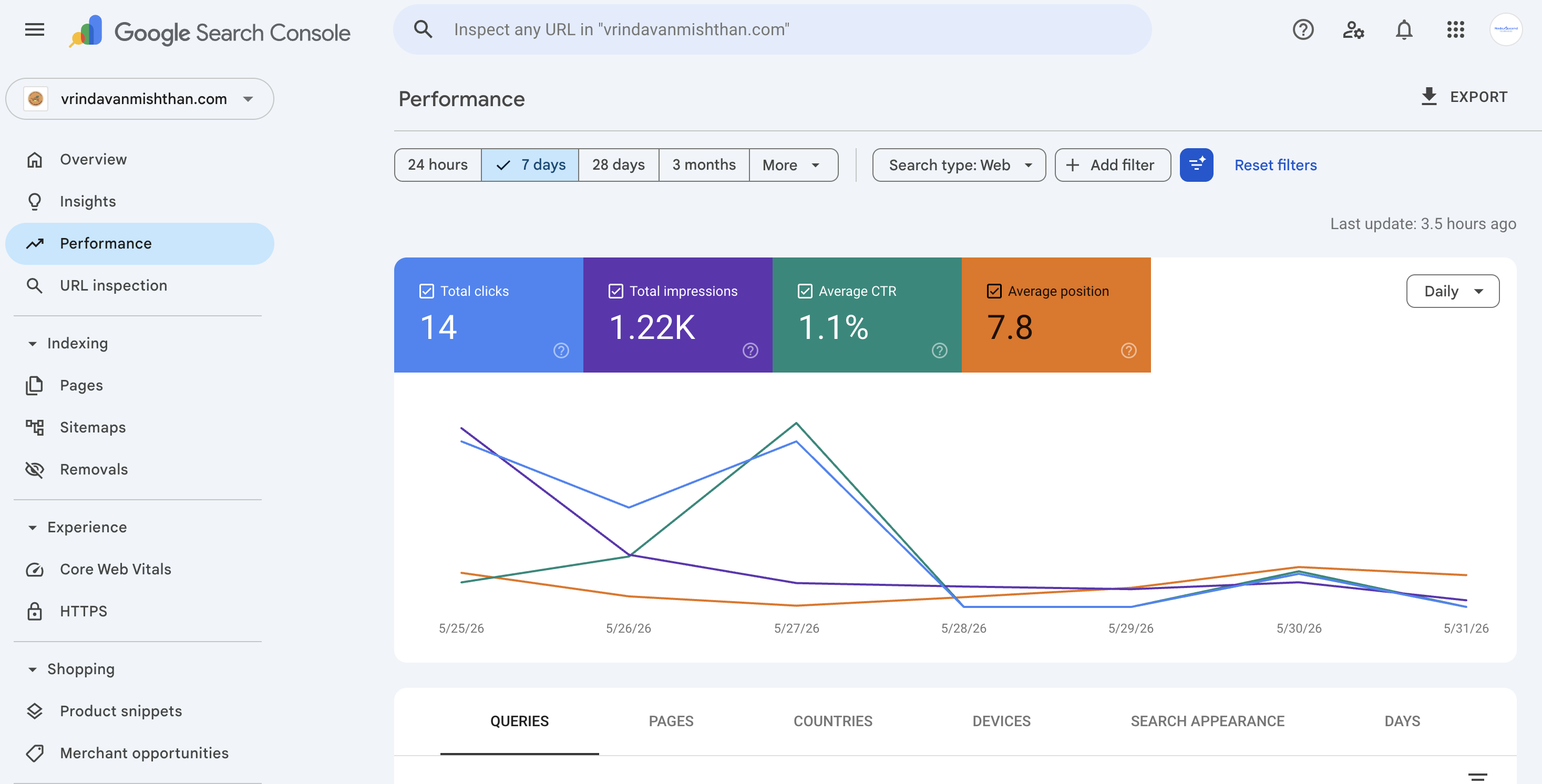
Here is what a real content performance report looks like. One of our clients, an NCR-based specialty food business, was averaging 1,220 impressions per week at an average position of 7.8 within their first month of structured content work — with 34 valid breadcrumb schemas, 25 FAQ schemas, and 3 review snippet schemas indexed by Google.
That result did not come from publishing daily. It came from publishing once with depth — a single piece with real product information, structured data markup, proper schema, and content that answered questions real buyers were asking.
The agency model of “we publish 8 blog posts per month” is a volume play designed to justify a retainer. Ask: “Of the last 20 blog posts you published for a client, how many are currently ranking on page 1, and what search volume do those keywords carry?”
If they cannot answer that question with specific data — URLs, keyword positions, traffic numbers — those posts are content inventory, not content assets. There is a difference.
Here is what a real content performance report looks like for a structured approach — not daily posting, just one properly built piece:
What performs in 2026:
- One 2,000-word piece built around a specific search intent, with original data or case study evidence
- Structured data markup so Google can feature it in rich results
- Internal links from high-authority pages on the same domain
- A distribution plan (indexing request, internal link update, GSC monitoring for 30 days)
What does not perform: a 500-word post stuffed with “digital marketing agency in Faridabad” published at 9am every Tuesday because the content calendar says so.
7. Not Leveraging Google’s Own Products Is Leaving Revenue on the Table
Google provides an entire ecosystem of free tools that directly influence how your business appears in search results. Most agencies do not know they exist. Even fewer know how to implement them correctly.
Here is what a properly configured small business presence looks like in Google Search Console:
Enhancements (Structured Data):
- Breadcrumbs: valid across all key pages — helps Google understand your site hierarchy and display cleaner search results
- FAQ schema: valid across product and service pages — triggers expandable FAQ rich results that double the SERP real estate your listing occupies
- Review snippets: valid — displays star ratings directly in search results, dramatically improving CTR
Merchant Center (for product-based businesses):
- All products approved and visible in Google Shopping
- Shipping policy verified
- Return policy verified
- Store ratings configured
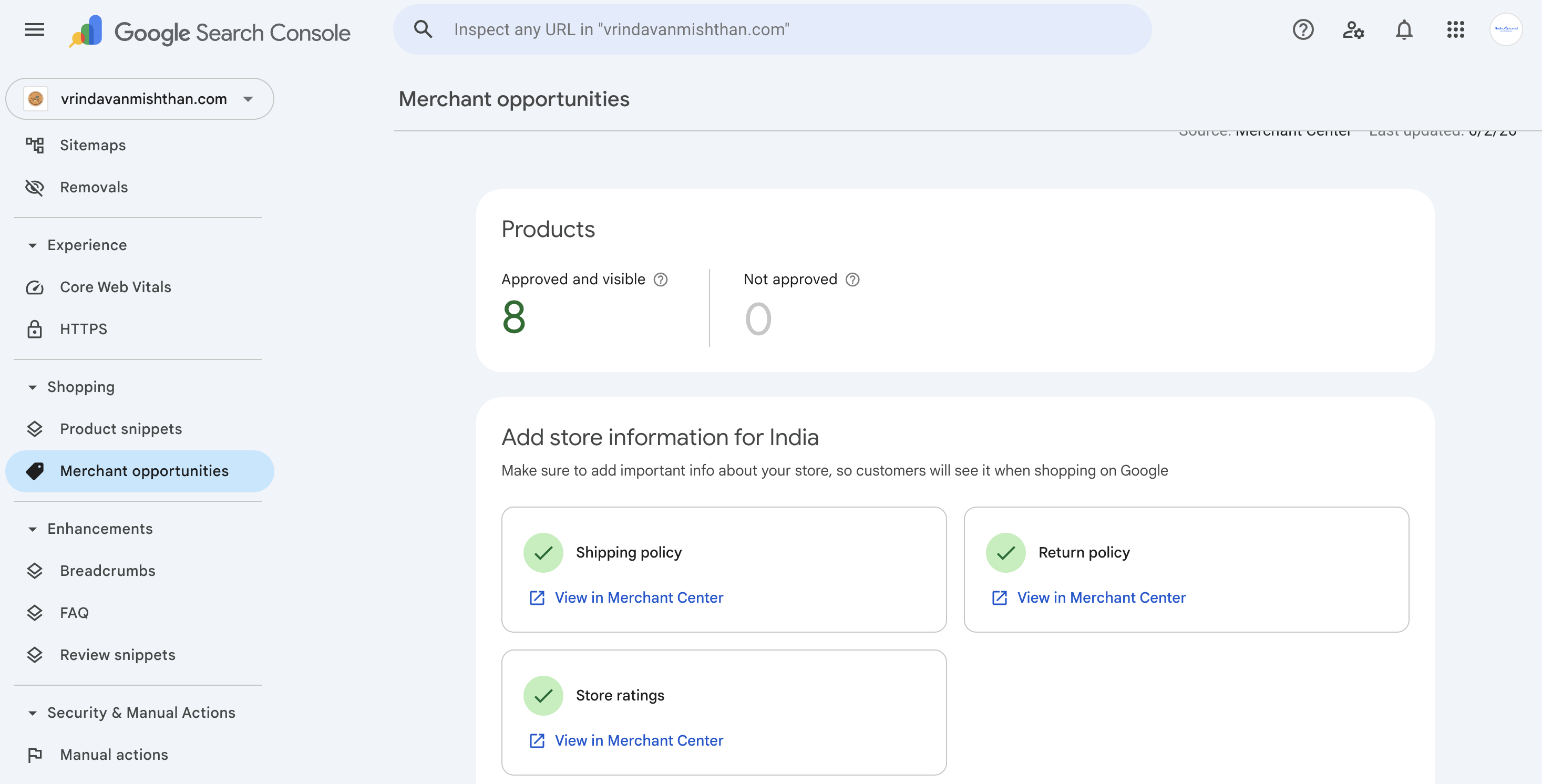
A business with all of this properly configured is not just “doing SEO.” It is occupying more Google real estate per search, signalling trustworthiness to Google’s systems, and getting free distribution through Google Shopping — without spending a rupee on ads.
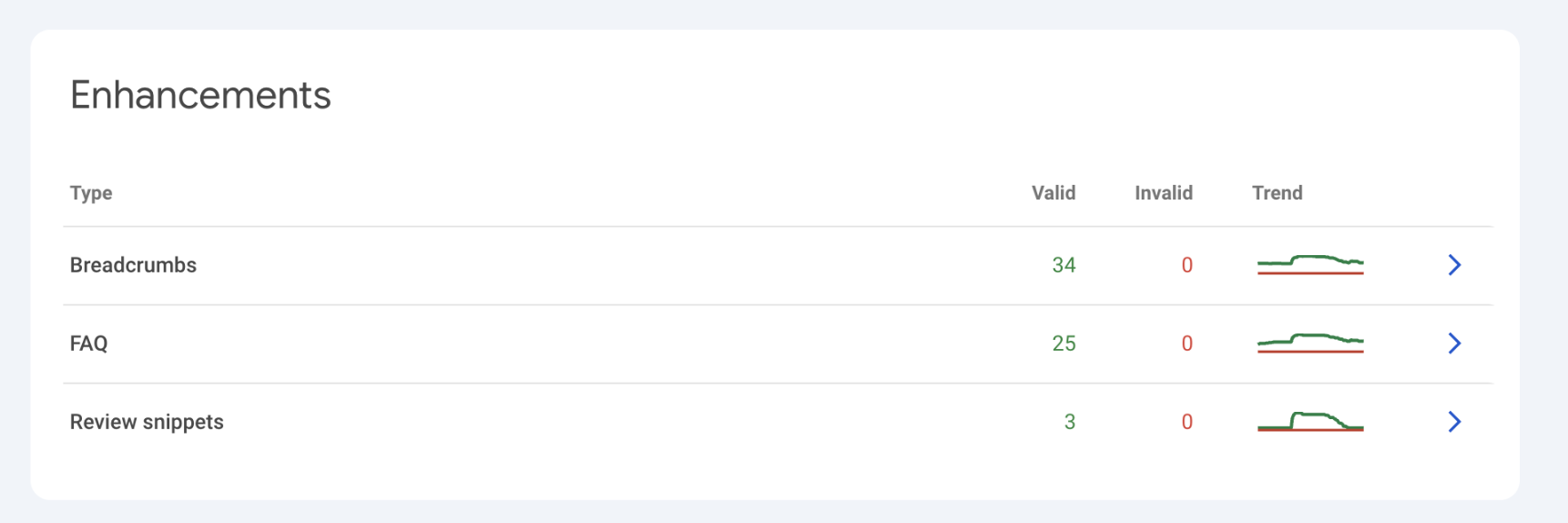
Most agencies in NCR deliver a keyword ranking report. Almost none deliver a structured data audit, a Merchant Center setup, or an enhancement validity report as part of their standard engagement. You are not getting what Google is ready to give you for free.
Ask any agency you are evaluating: “Can you show me what our current structured data coverage looks like in Search Console, and what enhancements are valid versus invalid?” Watch how they respond.
8. No Enhancement Data Shared With You = You Do Not Own Your Own Performance
The final and most damaging failure is opacity.
A business owner who has been paying for digital marketing for 12 months should be able to answer these questions without calling their agency:
- What is my site’s average position for my three most important keywords, right now?
- How many of my pages have valid FAQ or breadcrumb schema?
- What percentage of my organic traffic comes from India vs. other countries?
- How many form submissions last month were attributed to organic search?
- What was my site’s Core Web Vitals pass rate on mobile?
If you cannot answer any of these — if the data lives only inside your agency’s tools and dashboards — you do not have a marketing partner. You have a dependency.
Every piece of data about your digital performance should be in accounts you own: Google Analytics in your Gmail, Search Console verified under your email, Google Ads under your billing. Your agency should have access, not ownership.
What a Properly Run Digital Marketing Engagement Looks Like
Based on enterprise-level systems thinking applied to NCR businesses, here is what the first 90 days should produce — with specific deliverables you can verify independently:
Month 1 — Foundation
- Technical audit with Core Web Vitals baseline from Search Console
- Structured data implementation: breadcrumbs, FAQ schema, review snippets where applicable
- Google Business Profile optimisation with weekly post cadence
- Search Console performance baseline: top 20 queries, pages, and positions documented
Month 2 — Content With Measurement
- 1–2 long-form content pieces (1,500–2,500 words) targeting high-intent informational queries
- Each piece tracked in Search Console from day of indexing
- Internal linking audit — connecting new content to existing high-authority pages
- If e-commerce: Merchant Center product feed review and approval status check
Month 3 — Authority and Attribution
- Backlink acquisition from relevant NCR business directories and industry publications
- Conversion event tracking verified in GA4: form_submit, phone_call, whatsapp_click
- Monthly report with: keyword position delta, organic session trend, conversion count, and one specific recommendation for Month 4
By Day 90, you should be looking at a Search Console performance graph, a list of keywords that moved, and a GA4 report showing where your leads came from. If you are looking at a PDF of Instagram impressions, something went wrong.
About the Author
I am Sudhir Kaushik, founder of NodeAscend. My background is in enterprise-scale web infrastructure and digital systems — IndiaMART (B2B marketplace at millions-of-SKU scale), Cisco (network security product web), JIO Telecom (hundreds of millions of users), Tokopedia (Southeast Asia’s largest e-commerce platform), and Expedia (global travel at multi-region latency constraints).
What that background gives me is an understanding of web fundamentals that most agencies simply do not have: how servers behave under load, how Google’s crawl budget works at scale, why architecture decisions made at ₹5,000/month hosting eventually become the ceiling that limits your growth, and why content that is genuinely useful outlasts every algorithm update.
I built NodeAscend to bring that level of systems thinking to NCR businesses — manufacturers, service businesses, e-commerce brands — that deserve better than a ₹15,000/month package with a monthly PDF.
The Checklist: Questions to Ask Before You Sign
- Can you rank your own website for your target keywords? Show me the Search Console data.
- What is your content strategy based on — keyword volume or search intent? Walk me through a recent example.
- Which AI tools does your team use, and what specific tasks do they handle?
- How is my site hosted, and what is your DevOps recommendation for my traffic level?
- What CMS and framework do you recommend, and why — for my specific business?
- Show me a blog post you published for a client that is currently on page 1. What was the strategy?
- What structured data enhancements have you implemented for current clients? Can I see the GSC enhancement report?
- Will I own every account — Analytics, Search Console, Ads, Merchant Center — from day one?
- What does your 90-day report look like? (Ask for a real sample, not a template.)
- What happens to my campaigns if the person managing my account leaves your agency?
The Bottom Line
Finding the right digital marketing agency near you in Faridabad or NCR is not about finding the cheapest or the one with the most Instagram followers. It is about finding a team that understands how Google actually works in 2026 — not how it worked in 2015.
The agencies still running that old playbook are not bad people. They are just not keeping up. And in a market where Google is running AI models to evaluate your content and structured data to decide how much of its SERP to give you, “not keeping up” is expensive.
If you want a straight conversation about where your website actually stands — your Core Web Vitals, your structured data coverage, your Search Console performance, and what it would realistically take to move — talk to us. We will show you the data first, then have the conversation.
Visit our digital marketing services page to see how we approach this for Faridabad and NCR businesses.