We Build AI Agents the Same Way We Build Trading Systems
Because in regulated industries, wrong answers have consequences.
When you build a trading bot, the rules are unforgiving. The data pipeline either works or it doesn’t. The decision logic is either deterministic or it isn’t. The audit trail either exists or you’re in trouble. There is no “mostly correct.” A bot that fires the wrong order at the wrong price costs real money in real time — and no one accepts “the model was confident” as an explanation.
We have been building systems like that for over 10 years.
When pharma, banking, and insurance companies started asking us about AI — not chatbots, not demos, but production AI that reasons over internal documents and helps teams make defensible decisions — we realised we already knew how to think about this problem. We just needed to apply the same discipline to a different domain.
This is how we do it.
The Problem Nobody Says Out Loud
Your organisation has accumulated years of internal knowledge. SOPs. Regulatory submissions. Credit policies. Claims records. Batch data. Audit reports. Every time a new regulation lands, every time a product changes, every time an experienced employee leaves — that knowledge base grows, shifts, and becomes harder to navigate.
Right now, someone on your team is spending two or three hours answering a question that exists in a document on your own server.
That is not a knowledge problem. It is a retrieval problem.
The instinct is to reach for a cloud AI tool. Upload the documents, ask questions, get answers. It works in a demo. Then your compliance officer asks where the data goes, and the conversation ends.
Because it cannot go anywhere. Not for a pharma manufacturer with CDSCO filings. Not for a bank under RBI data localisation rules. Not for an insurer handling policyholder records under IRDAI guidelines. Not for an NBFC with SEBI scrutiny.
The data has to stay inside. Which means the AI has to come inside too.
What We Actually Built
We are not reselling a SaaS platform with a custom front end. We are writing the code.
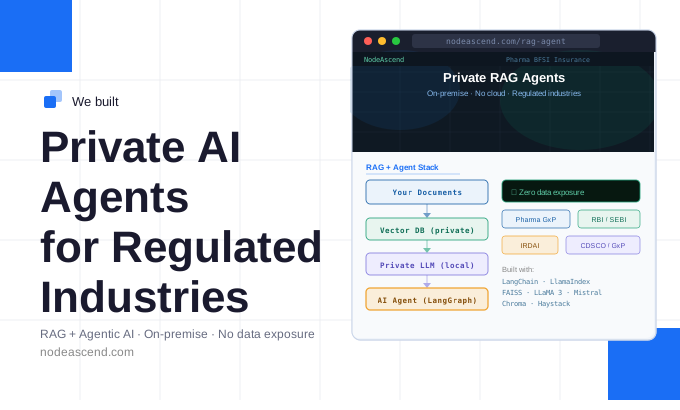
The architecture is called Retrieval-Augmented Generation with Agentic orchestration — RAG + Agents for short. Here is what that means in plain terms:
Step 1 — Your documents become searchable by meaning, not just keywords. We ingest everything: PDFs, Word files, scanned records, database exports. We parse them, chunk them intelligently — not by character count, but by semantic boundaries — and convert them into vector representations stored in a private database on your infrastructure. No document leaves your server.
Step 2 — A locally hosted language model reads only what it retrieves. When someone asks a question, the system finds the most relevant document sections from your private index and hands them to an open-source language model running on your hardware. LLaMA 3. Mistral 7B. Phi-3. Models that match or exceed GPT-3.5 performance on most enterprise benchmarks, running entirely within your walls, at roughly one-tenth the per-query cost of a cloud API at scale.
Step 3 — Every answer cites its source. This is non-negotiable for us, the same way an audit trail is non-negotiable in a trading system. If the model cannot point to the exact document section behind its answer, it does not answer. It says it does not know. That is the correct behaviour.
Step 4 — Agents handle multi-step workflows. A single RAG call answers a question. An agent completes a task. It can query your documents, check against a database, flag an inconsistency, draft a pre-populated report, and route it for human review — all in one orchestrated workflow. We build these using LangGraph and LlamaIndex, the same frameworks that power production enterprise deployments at scale globally.
Why the Trading Bot Background Matters Here
A trading system taught us three things that transfer directly to regulated AI:
Failure modes are expensive. In a trading bot, a wrong signal costs money. In a pharma compliance agent, a wrong answer could delay a regulatory submission or introduce a deviation. In a banking agent, it could mean a policy breach. We design for failure from day one — confidence thresholds, human-in-the-loop gates, contradiction detection, fallback behaviours. The system surfaces uncertainty rather than hiding it.
Audit trails are architecture, not afterthought. Every trade gets logged. Every AI query, retrieval event, and generated response gets logged too — immutably, with timestamp, user identity, and cited sources. Not because someone asked for it. Because that is how you build a system you can defend.
Pipelines either work or they do not. No “it was working yesterday.” We instrument everything. Retrieval accuracy is measured. Response latency is monitored. Document index freshness is tracked. When something degrades, we know before the user notices.
What This Looks Like for Your Industry
Pharma
Your QA team spends roughly 30–40% of their time searching for information rather than acting on it. A compliance question that crosses CDSCO guidelines, ICH requirements, and your internal SOPs simultaneously can take hours to answer manually — and the answer is only as good as the person who looked it up.
A private RAG agent answers it in seconds. It retrieves the relevant ICH section, the matching internal SOP, and the applicable CDSCO guidance simultaneously, generates a cited response, and logs the query. The analyst verifies the sources — which takes two minutes instead of two hours — and makes the decision.
The same agent can analyse batch records for deviations, draft pre-populated regulatory response letters, and flag pharmacovigilance signals against your internal safety database. All on-premise. All auditable. All compliant with Schedule M and 21 CFR Part 11 data integrity requirements.
Banking and NBFCs
An underwriter working a complex credit application needs to hold 40 or 50 internal policy documents in their head simultaneously. Nobody actually does that. They use the four or five they remember best and hope the rest do not matter.
An agent gives them a single interface. Ask any question about current credit policy. Get an answer that cites the exact clause. The system also flags whether a proposed deal structure conflicts with the current product programme — something that currently gets caught in credit committee if it gets caught at all.
Insurance
A complex hospital claim lands on a claims analyst’s desk. They need to cross-reference the policy wording, endorsements, exclusion clauses, IRDAI guidelines, and historical precedents before making a call. An agent does the retrieval and comparison in seconds, surfaces contradictions between the claim and the policy terms, and drafts the initial assessment with citations. The analyst makes the decision. The agent handled the document work.
Finance and Compliance Teams
New RBI circulars. New SEBI notifications. New IRDAI guidelines. They arrive continuously and someone has to map each one to your internal policies and figure out what needs updating. An agent that monitors regulatory feeds, maps new requirements to your policy inventory, and produces a prioritised action list every morning transforms that from a monthly fire drill into a daily two-minute review.
The Stack We Use
We select tools based on your specific data topology and infrastructure, not based on what we happen to know best. That said, here is what we reach for in production:
Document ingestion: Unstructured.io, Apache Tika, custom Python parsers for legacy formats. OCR for scanned records.
Vector storage: Chroma, FAISS, or Qdrant — all self-hosted. We have deployed all three in production and have clear opinions on when to use which.
Embedding models: BGE-M3 and E5-Mistral for most use cases. Run locally, no API calls.
Language models: LLaMA 3, Mistral 7B, Phi-3. Quantised for your hardware profile. We size the model to what your servers can run reliably, not to what looks impressive in a benchmark.
Agent orchestration: LangGraph for complex multi-step reasoning and stateful workflows. LlamaIndex for document-heavy retrieval. CrewAI when the task benefits from role-based multi-agent coordination.
Evaluation: RAGAS and DeepEval for measuring retrieval accuracy and response quality. Not just at launch — on an ongoing basis, because accuracy drifts when document volumes grow.
The Hallucination Question
Every compliance officer asks this and they are right to ask.
In a standard language model, hallucination is a model problem. In a well-built RAG system, it becomes a design problem — one you can actually solve.
The model can only generate from what it retrieves. If the document is not in your knowledge base, the system says it does not know rather than inventing an answer. We reinforce this with:
Confidence thresholds. If retrieval relevance falls below a set score, the response routes to human review rather than generating at all.
Citation enforcement. No source citation, no answer. This is a hard rule, not a preference.
Contradiction detection. When retrieved documents conflict — an old policy and a new one covering the same scenario — the system surfaces both and flags the conflict rather than arbitrarily choosing one. Because in a regulated context, the right answer to a contradiction is “this needs human judgment,” not a coin flip.
This is not a perfect system. But it is a system whose failure modes are visible, bounded, and manageable. Which is all you can really ask for.
How a Project Actually Runs
We do not do six-month discovery engagements. We build something working, put it in front of your users, and iterate from there.
Weeks 1–3: Discovery. We map your document landscape. We identify the single highest-value starting point — the use case where the retrieval problem is costing the most time or risk right now. We define what “accurate” means for your domain and build a test set to measure against it.
Weeks 4–8: Proof of concept. We ingest a representative document sample, deploy the vector database and local LLM, build a basic interface, and measure accuracy against your test set. You have a working system before any major infrastructure commitment. We iterate on chunking strategy and retrieval configuration until the numbers are where they need to be.
Weeks 9–18: Production build. Full document ingestion. Agent orchestration. Integration with your existing systems — LIMS, ERP, document management, whatever the relevant stack is. RBAC, audit logging, PII masking. Performance testing at scale. User training.
Ongoing. Automated re-indexing as documents are added or updated. Accuracy tracking. Agent capability expansion as new use cases are identified.
One Thing We Will Tell You That Most Vendors Will Not
There are use cases where this is not the right answer yet.
If your documents are extremely low quality — heavily scanned, inconsistently structured, with no metadata — the retrieval accuracy will disappoint you until the document hygiene problem is fixed first. We will tell you that upfront rather than taking the project and managing your expectations downward for six months.
If your primary need is a simple FAQ bot with 20 questions and stable answers, there are cheaper ways to build that.
If you need a system where an AI makes autonomous high-stakes decisions without human review, we will push back on that scope until we have established the accuracy baseline together. Not because we cannot build it technically, but because “confident and wrong” with no human gate is a liability, not a product.
We are engineers. We will tell you when a simpler solution is the right one.
If This Is the Problem You Are Sitting On
Start with a conversation, not a proposal. Tell us what your team is searching for manually that they should not have to. Tell us what questions take hours to answer that exist in your own documents. Tell us what keeps your compliance team up before an audit.
We will tell you whether RAG + Agents solves it, how long it would take to find out, and what a working prototype would cost.
[email protected] · +91-9582818240
NodeAscend Technologies. Faridabad, Haryana. Engineering-led AI development for organisations where wrong answers have consequences.
AI & Automation · Software Development · IT Consulting