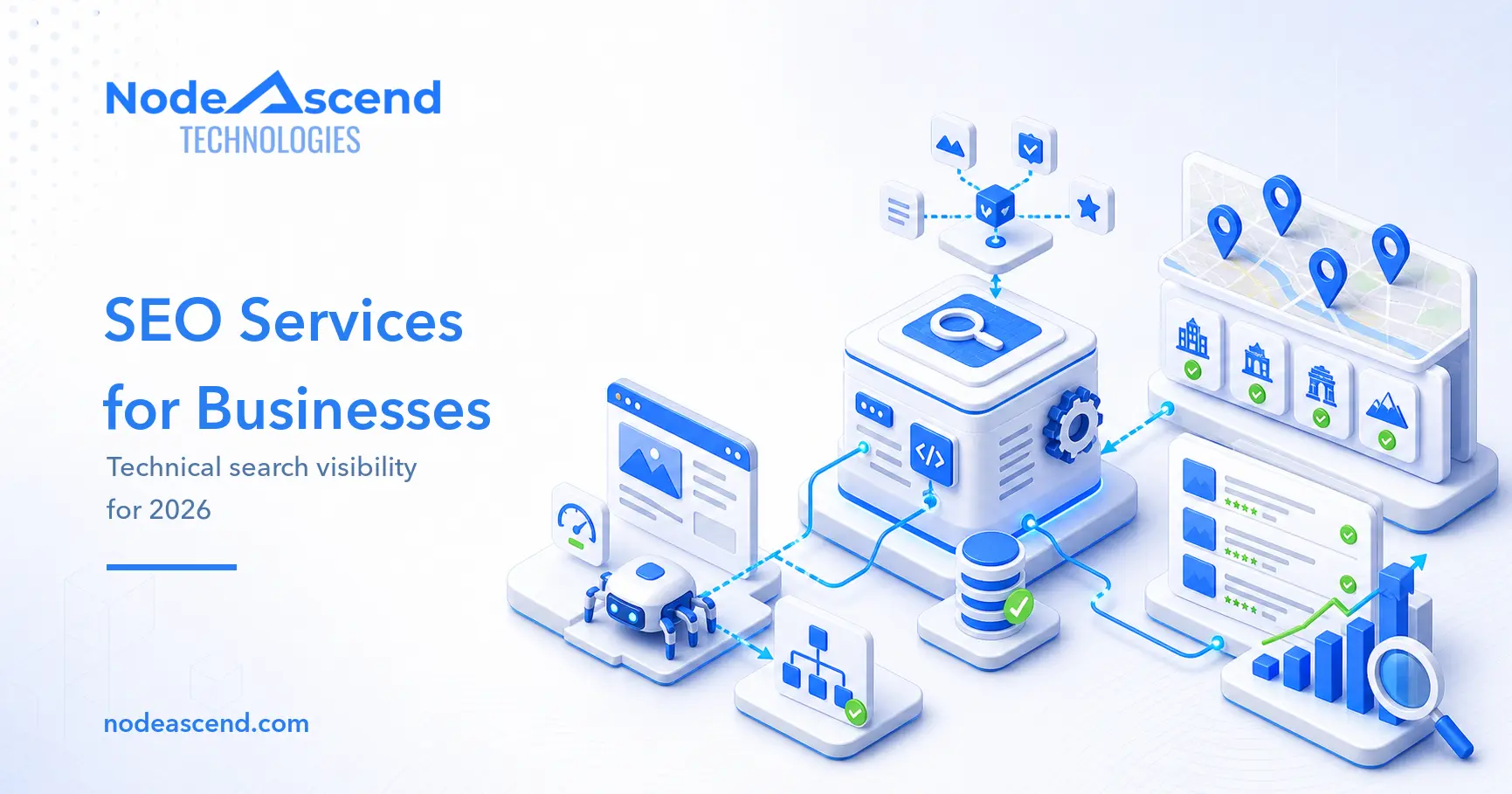
SEO services in Delhi NCR have to start with a hard look at intent — not a keyword list. Delhi NCR isn’t one neat market, no matter how often agencies treat it like one. A buyer in Delhi might be comparing established agencies one by one. A Gurgaon founder cares about B2B authority more than anything else. A Noida SaaS team needs technical SEO and content architecture done right. A Faridabad manufacturer wants local trust and visibility with industrial buyers specifically. The region overlaps geographically, sure — but the searcher behind every query still wants a page that feels written for their problem, not a generic one stretched across five cities.
That’s exactly where most campaigns go sideways. One broad page gets built, city names get sprinkled in like seasoning, a few blog posts get published, and then everyone waits. Google is left guessing what the business actually deserves to rank for. Users feel the same confusion from the other side — the page might say “best SEO company,” but it shows none of the actual work, none of the market understanding, no real reason to trust the team behind it.
NodeAscend’s SEO services in Delhi NCR are built around technical clarity, local relevance, useful content, and measurement you can actually verify. No tricks. No guarantees nobody can ethically make. Work you can check yourself, inside Search Console.
The Delhi NCR SEO problem, in three parts
Delhi NCR carries three SEO realities at once, and they don’t cancel each other out.
First — the competition is dense. Most businesses already have service pages, Google profiles, directory listings, and domains with years of age on them. A new or weak page won’t out-rank that just by repeating a keyword a few more times.
Second — search intent is genuinely mixed. Someone typing “SEO services in Delhi NCR” might want a local SEO team, a technical audit, ecommerce SEO, B2B content work, AI SEO, or a full digital marketing partner. One page has to help that person figure out which one they actually need.
Third — and this surprises people — proximity still matters more than the “SEO is dead, it’s all AI now” crowd wants to admit. Google blends organic results with Maps, directories, review sites, and city-specific pages constantly. Your website, your Google Business Profile, citations, reviews, and service-area language all need to agree with each other, or the whole picture gets muddier than it should.
What a serious SEO engagement should actually include
Month one shouldn’t be a content sprint. It should be a diagnostic month — full stop, no shortcuts.
A real SEO audit checks whether Google can even crawl the site properly, whether the important pages are indexed at all, whether titles and descriptions match what people are actually searching for, whether old URLs are quietly wasting authority, whether pages are competing against each other for the same query, and whether leads get tracked correctly once they arrive. Skip that baseline and every recommendation that follows is just a guess wearing a spreadsheet.
The work itself usually spans technical SEO, local SEO, content strategy, Google Business Profile improvement, citation cleanup, review strategy, internal linking, page rewrites, and reporting that means something. For some businesses, link acquisition and digital PR matter early on. For others, the bigger win is something less glamorous — fixing a slow website, thin service pages, or conversion tracking that’s been broken for months without anyone noticing.
Technical SEO comes before scale, always
Technical SEO gets skipped constantly — precisely because it’s unglamorous. But it decides how much of your website Google is even willing to trust in the first place.
We look at crawl paths, canonicals, redirects, duplicate pages, indexation, Core Web Vitals, schema, mobile usability, broken links, sitemap coverage, robots rules, JavaScript rendering, and page templates. A site can have genuinely good content and still underperform, simply because Google is viewing all of it through a messy technical layer underneath.
Speed matters twice over for Delhi NCR businesses specifically. It feeds ranking signals directly, and it shapes paid and organic conversion at the same time. Nobody on mobile is going to politely wait for a heavy page to finish loading just because the headline promises “best in Faridabad.”
Local SEO is more than just Google Maps
Google Business Profile matters, obviously — but local SEO isn’t only Maps. It’s the agreement between your profile, your website, your citations, your reviews, your service pages, and your actual real-world service area.
A local SEO campaign should be able to answer some uncomfortably simple questions:
- Is the business name consistent everywhere?
- Is the phone number correct on every single platform?
- Are categories chosen properly, not just defaulted to “general”?
- Do the reviews actually mention real services?
- Do service pages explain which areas get served?
- Does the website load quickly on an average mobile connection?
- Are calls, forms, and WhatsApp clicks actually being tracked?
Directories matter when they’re genuinely relevant — not as a blanket rule. For B2B and manufacturing businesses, IndiaMART creates real visibility because buyers already use it for supplier discovery; it’s not a nice-to-have, it’s where they’re already looking. For clinics, schools, local services, and professional firms, other trusted directories and review platforms carry more weight instead. The goal was never to list the business everywhere possible. It’s to show up accurately, exactly where buyers are actually looking.
Content should reduce doubt, not just describe the offer
A good SEO page doesn’t stop at saying what you offer. It has to chip away at the buyer’s hesitation, line by line.
For SEO services specifically, buyers want to know what happens in month one, what access the team needs, how reporting actually works, what’s realistic to expect, what nobody can honestly guarantee, and how the team decides what to change next. Dodge those questions on the page and you might still rank for a while — but conversion will quietly suffer the whole time.
Good content also keeps similar-sounding intents apart instead of mashing them together. “SEO company,” “SEO expert,” “technical SEO audit,” “local SEO,” “AI SEO,” and “digital marketing agency” shouldn’t all get crammed onto one page as if they mean the same thing to a searcher. They overlap conceptually. Buyers use them very differently in practice.
Search Console decides what gets changed next
After a content push, the temptation is to keep tweaking the page daily. Resist it — that usually just creates noise nobody can read. Wait for indexing to settle, then look at the actual evidence.
Search Console will show whether impressions climbed, which queries started appearing, which page actually ranked, whether CTR improved at all, and whether average position moved in either direction. If impressions rise but clicks stay flat, the title, meta description, or above-fold proof is probably weak. If the wrong page ends up ranking, internal links and headings are likely confusing Google more than helping it. If rankings improve but leads don’t follow, the page might be attracting the wrong intent entirely.
That’s the grown-up version of SEO, really: publish, measure, amend, repeat — and resist the urge to skip straight to step four.
FAQ
Can anyone guarantee top 10 rankings in Delhi NCR?
No, and anyone promising it should raise an eyebrow. Google rankings depend on competition, relevance, authority, location, search intent, and ongoing algorithm changes nobody fully controls. A serious SEO team can explain the work clearly and measure progress honestly — but it can’t ethically guarantee a fixed position.
How long does SEO actually take?
Technical fixes can show early signals within weeks. Competitive service keywords across Delhi NCR usually need three to six months of steady work, sometimes longer if the site is starting with weak authority or facing heavy competition head-on.
Should SEO and ads run together?
Often, yes. Ads can test offers and landing pages fast. SEO builds visibility that lasts well beyond any campaign’s end date. The right sequence depends on budget, urgency, margins, and how well the website already converts.
What should get checked first?
Start with GSC, GA4, technical crawl data, current rankings, page-level CTR, indexed pages, the Google Business Profile, citations, and conversion tracking. Those signals together usually point straight at the highest-leverage fixes.
Next step
If your Delhi NCR SEO campaign keeps producing reports but not enquiries, start by finding exactly where the system is leaking. Request an SEO audit from NodeAscend.