A business owner approves a ₹2 lakh website proposal. Three weeks later, the agency installs a ₹5,000 theme, swaps the logo, imports demo pages and places the site on an overcrowded shared server. The home page looks polished in a presentation and takes six seconds to become usable on a mid-range phone.
That is not a bargain. It is margin-first delivery disguised as custom design.
Good website design in India should give the business a clear customer journey, original visual direction, responsive behaviour, honest technical choices and a measurable performance baseline. The framework matters, but it comes after the job the website must do.
NodeAscend is the development partner agencies call when the brief has outgrown a template. We turn brand and campaign thinking into fast, technically sound websites that an SEO team can confidently take to market.
This guide is for owners in Noida, Gurugram, Dehradun, Faridabad and across India who want to tell the difference before signing the proposal.
Key takeaways
- A theme is not automatically bad, but it should never be sold as original design.
- WordPress, Astro and Next.js serve different teams and product requirements.
- Purposeful motion guides attention; decorative motion slows people down.
- Responsive design includes content, interaction and accessibility, not only smaller boxes.
- PageSpeed is a design and architecture responsibility from the first wireframe.
- PWA features should solve a repeat-use problem rather than decorate a pitch deck.
The template-and-hosting trap
Cheap themes make it possible to launch quickly. They also make it easy to hide what the client is buying.
A typical weak delivery looks like this:
- Choose a theme designed for a different industry.
- Replace photographs and headings.
- Add plugins for forms, animation, SEO, caching, security and backups.
- Put several unrelated client sites on the same low-cost hosting account.
- Call the result custom because the colours changed.
The problem is not that the site uses WordPress or a template. The problem is the gap between the invoice and the work.
An honest proposal should say whether the visual system is original, adapted from a component library or based on a commercial theme. It should identify who owns the theme licence, where the site will be hosted, which plugins renew annually and who handles updates when one of them breaks.
Shared hosting can be perfectly reasonable for a small low-traffic site. It becomes a poor choice when the provider packs accounts together, gives no resource guarantees and has no answer for traffic spikes, malware isolation or slow database queries.
Ask the agency what happens after launch. “We will install a cache plugin” is not an architecture plan.
PHP did not disappear, and JavaScript is not a strategy
There is a popular sales line that Facebook “removed PHP” and therefore every serious business should use a JavaScript framework. The history is more interesting.
Facebook developed Hack, a language with deep PHP roots, and migrated nearly its entire PHP codebase to it. Meta’s own engineering announcement describes Hack as interoperating with PHP while adding gradual typing and other language features. Read Meta’s account of the migration.
That story proves that large teams evolve their stack around their constraints. It does not prove that a five-page clinic website needs the architecture of Facebook.
The useful comparison is simpler:
| Stack | Strong fit | Trade-off to discuss |
|---|---|---|
| WordPress | Frequent publishing by non-technical editors, mature plugin needs | Maintenance, plugin quality and runtime overhead |
| Astro | Marketing, editorial and portfolio sites where most content can ship as HTML | Interactive features need deliberate islands or services |
| Next.js | Product-adjacent websites, authenticated flows and React applications | More runtime and deployment complexity when used for a simple brochure site |
| Shopify | Commerce where catalogue, checkout and operations fit the platform | App cost, theme constraints and platform-specific customisation |
| Custom backend | Unique business workflows, portals and integrations | Higher discovery, testing and ownership responsibility |
At NodeAscend, Astro is a frequent choice for content-led sites because it can ship very little client-side JavaScript by default. Next.js makes sense when the website sits close to a product experience. WordPress remains defensible when the editorial workflow genuinely needs it.
The right answer is rarely “everyone uses JavaScript now.” The right answer explains what the business gains and what the team must maintain.
What intentional website design services in India should deliver
Beautiful websites are not collections of effects. They create a sequence.
The first screen establishes what the company does and why the visitor should care. Typography creates pace. Images prove the product. Whitespace makes the hierarchy legible. Motion helps a section enter at the moment it becomes relevant. The next action appears when the visitor has enough context to take it.
We use six principles when reviewing a design:
A recognisable visual idea
The page should feel connected to the business, not to the theme marketplace. The material, audience, language and buying decision should influence type, colour, photography and layout.
Editorial hierarchy
Large headings alone do not create hierarchy. Contrast between display type, supporting explanation, evidence and action helps a reader scan without losing the story.
Motion with a job
Scroll-based reveals can show sequence, compare states or create a sense of depth. They should not delay access to information. Every motion system needs a reduced-motion fallback.
Mobile behaviour designed separately
Desktop layouts do not become mobile designs by shrinking. Navigation, touch targets, content order, image crops, forms and animation density all need another decision.
Accessibility in the visual system
Contrast, focus styles, keyboard use, meaningful structure and readable type belong in design review. Fixing them after development is slower and usually less coherent.
Conversion without desperation
The call to action should match the decision. A buyer researching a complex service may need a project brief or audit. A customer choosing a physical product may need a sample. Five floating buttons do not create five times the intent.
These are the qualities people notice on highly regarded design showcases even when they cannot name them: restraint, rhythm, craft, a coherent interaction idea and technical execution that does not collapse on mobile.
High-performance websites built to rank from day 1
Google’s Core Web Vitals measure loading performance, responsiveness and visual stability using Largest Contentful Paint, Interaction to Next Paint and Cumulative Layout Shift. Google’s guidance for business decision-makers connects better user experience with engagement and conversion outcomes. See the Core Web Vitals business guide.
“Built to rank from day 1” does not mean an honest agency can promise a first-page position on launch day. It means the website launches with the technical foundation search engines and users need: crawlable HTML, one clear H1, descriptive titles, canonical URLs, structured data where appropriate, logical internal links, an XML sitemap, useful location signals and pages fast enough to support a good experience. Rankings still depend on competition, authority, content quality and continued SEO work.
The important point for a buyer is that design decisions create many performance problems:
- an oversized hero video;
- four font families with unnecessary weights;
- a carousel nobody asked for;
- animation libraries loaded on every page;
- third-party chat and tracking scripts added without a budget;
- images without defined dimensions;
- a layout that moves when late content arrives.
We set a performance budget before development. The intended hero format, font count, motion approach, third-party scripts and interactive components are discussed while the design can still change cheaply.
NodeAscend targets 90+ PageSpeed for suitable marketing websites, then reports the actual test rather than presenting the target as a universal guarantee. Aurum’s existing case study records a mobile score of 89 for an image- and motion-rich site. That honest number is more useful than pretending every page always scores 100.
Two projects, two different visual systems
SNUG Fit: the product needed an atmosphere
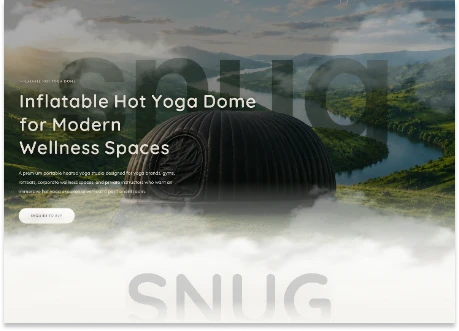
SNUG Fit sells portable inflatable heated-yoga environments. A generic fitness template would have reduced an unusual physical experience to cards and feature bullets.
The live Astro site uses immersive imagery, controlled scroll sequences, responsive scene changes and an interactive 3D dome model. The interaction supports a specific sales problem: many visitors have never seen the product category before.
Aurum Wall Decor: luxury needed restraint
Aurum Wall Decor required a digital showroom for ultra-thin natural stone surfaces. The design uses editorial typography, a warm material-led palette, deliberate motion and a “Request Sample” path that matches how the product is evaluated.
It does not look like SNUG Fit because the businesses do not ask visitors to feel the same thing.
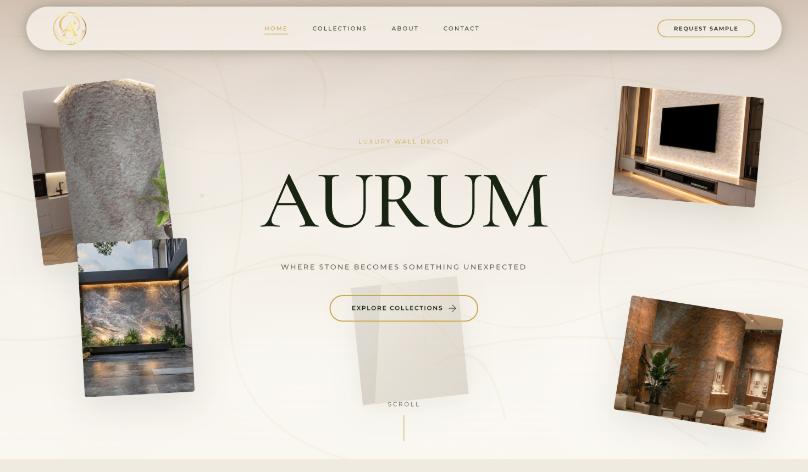
That is the standard a portfolio should demonstrate: different visual answers supported by a consistent engineering discipline.
Responsive, PWA-capable and honest about location
Every serious build should be responsive. PWA capability is more conditional.
An installable experience, offline data, background sync or push notifications can be valuable for a field tool, repeat booking product or operational application. A corporate marketing website may gain nothing from an installation prompt. We keep the architecture capable of supporting those features when the user need exists, rather than selling “PWA-ready” as decoration.
NodeAscend is based in Faridabad and serves clients remotely. For Noida, that often means B2B, SaaS, software and technical-SEO considerations. Gurugram businesses may need product marketing, recruitment or enterprise integrations. Dehradun projects often connect websites to admissions, hospitality, wellness, healthcare or direct enquiries.
The same remote model can support Bengaluru, Mumbai, Hyderabad and Pune. It does not require pretending there is a NodeAscend office in each city. Discovery calls, workshops, Figma reviews, staging releases, content approval and handover all work online when the process is clear.
Buyers in Noida can review the Noida service approach, while Gurugram and Dehradun have their own context on the Gurgaon web design page and Dehradun services page.
Why other agencies hire NodeAscend for website delivery
Design studios, branding firms, SEO consultants and performance-marketing agencies hire NodeAscend when they need a technical partner who will protect the original idea and make it work in production. They may own the strategy and client relationship while our developers handle the build, or we can join delivery calls as the engineering team.
Typical agency-partner work includes Astro and Next.js development, responsive component systems, scroll-based animation, CMS integration, landing-page production, PWA features, analytics, schema, API connections, hosting and Core Web Vitals improvement. We can work as a white-label website development partner or as a named specialist, with clear scope and handover in either model.
This is where “the agency other agencies hire” has substance. The value is not a secret template. It is the ability to translate creative direction into a reliable, searchable and maintainable website without weakening the design or passing technical problems back to the lead agency.
What to ask before signing a web design proposal
Ask questions that reveal the work behind the mockup:
- Is the visual design original, component-based or theme-based?
- Who owns the design files, code, domain, analytics and hosting account?
- Which mobile states are designed rather than improvised during development?
- What performance budget applies to images, fonts, motion and scripts?
- How will content be edited after launch?
- Which accessibility checks are included?
- What happens when a form, API or third-party service fails?
- Is PWA functionality solving a named use case?
- What evidence from the portfolio can be reviewed live?
- Who supports the website three months after launch?
A strong agency will enjoy this conversation. The answers are the product.
If your current proposal is expensive but vague about design ownership, hosting, performance and handover, NodeAscend can give you an engineering-led second opinion through our website design services.
Frequently Asked Questions
Is WordPress always a bad choice for a business website?
No. WordPress can suit editorial teams that publish frequently and need a mature visual CMS. The problem is choosing it by default, then adding a heavy theme and plugins without a performance or maintenance plan. Architecture should follow the team and the website's job.
Should every website be built as a PWA?
No. PWA features are useful when installability, offline access, push notifications or repeat app-like use supports a real user need. A marketing site may need only a fast responsive experience. PWA capability should be scoped, not added as a badge.
Can NodeAscend deliver web design to Noida, Gurgaon and Dehradun remotely?
Yes. NodeAscend operates from Faridabad and works remotely with clients in Noida, Gurugram, Dehradun and other markets. Research, workshops, reviews and handover are run online without implying a physical office in those cities.
Does NodeAscend guarantee a 90+ PageSpeed score?
We set a 90+ target for suitable marketing builds and test the finished pages, but a responsible team should not guarantee one score for every page and device. Third-party scripts, media, hosting, consent tools and user conditions affect the result.
What should a web design proposal include?
It should define research, information architecture, wireframes, visual design, responsive states, content responsibility, development stack, CMS needs, integrations, accessibility, performance testing, analytics, ownership, hosting, handover and post-launch support.
Why do other agencies hire NodeAscend for website delivery?
Design, SEO and marketing agencies hire NodeAscend when a project needs stronger development depth, performance engineering, technical SEO, JavaScript frameworks, custom integrations or dependable white-label delivery. We can work behind the agency or directly with its delivery team.