Google confirmed the August 2026 spam update on Tuesday 18 August and marked the rollout complete on Friday 21 August — roughly two days and sixteen hours. Then the questions started arriving. Were we hit? Were our clients hit? What are you doing about it?
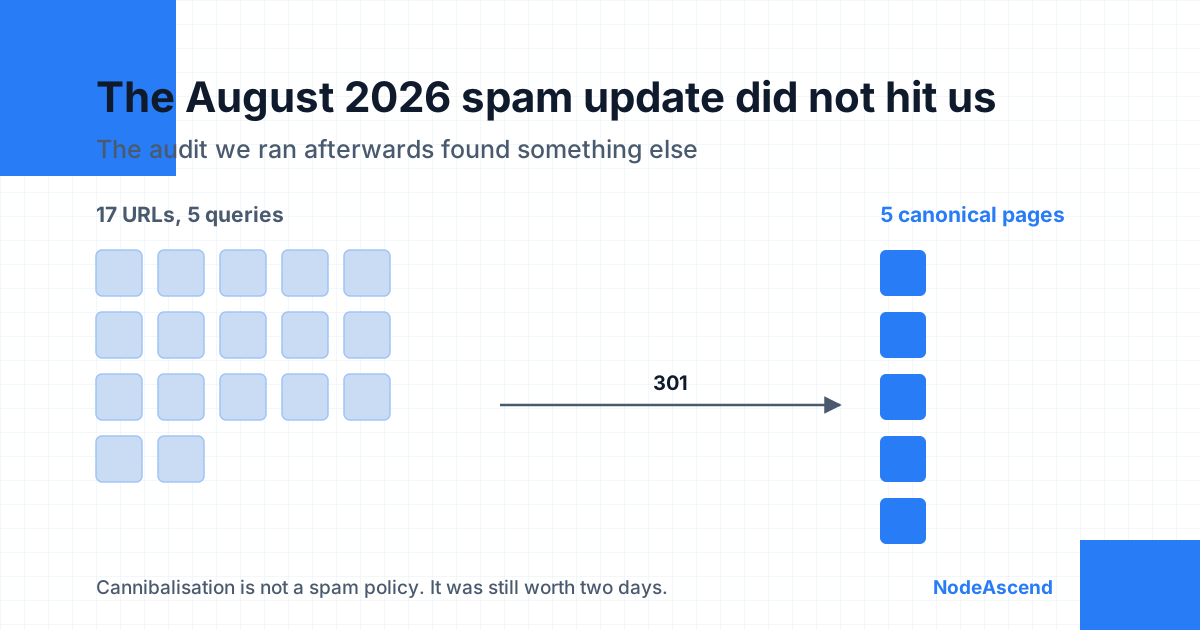
The August 2026 spam update targeted scaled content abuse, AI-generated content published at volume, thin affiliate pages and programmatically generated URLs. It did not target keyword cannibalisation, which is not a Google spam policy at all. We audited our own site anyway, because an update is a good excuse to look properly. The audit found seventeen NodeAscend URLs competing for five queries.
This is what we found and what we changed, written up while the redirects were still warm. The methodology sits under our SEO services in India work, and the pages involved are our own, so every number here is checkable against the repository.
Key takeaways
- The update ran 18–21 August 2026, globally, with no new spam policies published alongside it.
- It hit content-quality violations, not site architecture. Cannibalisation was never in scope.
- Our audit found 17 URLs chasing 5 queries. Twelve live URLs are now 301’d into five canonical pages.
- The sharper problem was the footer: every page on the site linked to sixteen near-identical city and service URLs.
- We are not claiming a recovery. There was no penalty to recover from, and the consolidation is too recent to have produced a trend.
What the August 2026 spam update actually was
It was the third spam update of 2026, after March and June. Google announced it on the Search Status Dashboard, rolled it out globally across all languages, and published no accompanying blog post and no new policies. The existing spam policies documentation remained the reference.
The impact was larger than a typical spam update. According to SE Ranking data reported by Search Engine Land, 16.71% of URLs previously ranking in the top ten fell beyond position 100 during the rollout, against 9.2% in a comparable July window — an 82% increase, making a top-ten URL about 1.8 times more likely to disappear entirely. Volatility ran from roughly 75% in real estate to 86% in fashion and beauty.
Those are big numbers, and they are why the phones rang. They are also averages across twenty niches, which tells you nothing about whether your particular site moved.
What it hit, and what it did not
The published case studies point consistently in one direction: content generated at scale without value added. Sites with hundreds of thousands of programmatic URLs. AI-written sections on health and finance pages. Affiliate pages carrying little beyond links to a merchant. Sites redirecting visitors onward to riskier domains.
Look down Google’s list of named spam policies — cloaking, doorway abuse, expired domain abuse, keyword stuffing, link spam, scaled content abuse, scraping, site reputation, sneaky redirects, thin affiliation — and keyword cannibalisation is not on it. Two of your own pages competing for one query is not deceptive. It is inefficient. Google resolves it by picking one, and the one it picks is frequently not the one you would have chosen.
There is one edge worth naming honestly. Doorway abuse covers “substantially similar pages”, and a site with nineteen near-identical city-and-service URLs, linked from a sitewide footer, is closer to that line than its owner usually thinks. That was the uncomfortable part of our own audit, and it is the reason we did the work despite not having been hit.
What our audit found instead
We started from a URL inventory generated on 20 July 2026: 87 built pages, 85 in the sitemap, of which nineteen sat in a group our own tooling had already labelled faridabad-money-or-support. Nineteen commercial URLs for one city of roughly 1.4 million people, published by a team of our size, is not a content strategy. It is an accident that accumulated.
Grouping them by the query each one was actually written to win produced this:
| Query cluster | URLs competing | Absorbed into |
|---|---|---|
| SEO in Faridabad | 3 | /seo-company-in-faridabad/ |
| Digital marketing in Faridabad | 3 | /best-digital-marketing-company-in-faridabad/ |
| Website designing in Faridabad | 4 | /website-designing-company-in-faridabad/ |
| Website development in Faridabad | 4 | /website-development-company-in-faridabad/ |
| SEO in Delhi NCR | 3 | /seo-services-delhi-ncr/ |
Seventeen URLs, five queries. Two of the seventeen were blog posts competing with our own service pages — the exact pattern our internal governance document forbids, published before that document existed.
One of those two could not be fixed by rewriting. /blog/seo-company-in-faridabad-for-manufacturers/ carried the service page’s exact primary keyword inside its own slug, so no amount of retitling would stop the URL itself from competing. Its unique material — the five-vendors-and-no-owner framing, the named industrial belts, the sequencing from profile to website to listings — moved into the service page, and the post was retired with a 301.
We also found a URL listed in our own /sitemap/ page for which no content file had ever existed. It now redirects rather than 404s.
What we changed, in the order we changed it
Twelve live URLs and one ghost URL are now 301’d into five canonical destinations. That was the least interesting part of the work.
The footer was the real offence
Our footer carried “Services in Faridabad” and “Services by City” columns, which meant every page on the site linked to sixteen near-identical city-and-service URLs. Cannibalisation caused by drift is forgivable. A sitewide template that pushes link equity into sixteen thin variants of the same commercial page is the pattern that makes it look deliberate.
Those columns are now a single Locations column of city hubs. There is a real trade-off, and it is worth stating rather than glossing: the Faridabad money pages lost their sitewide footer links. They keep inbound links from the city hubs, from the national pillars, from same-city cross-service links and from the blog. We think concentrated links to five pages beat diffuse links to nineteen. We will know in a quarter.
Sideways links between cities
We removed 32 links of the form “SEO in Gurgaon → SEO in Noida”. A reader on a Gurgaon page has no plausible need for the Noida equivalent; those links existed to move crawlers, which is a reason to distrust them. Same-city cross-service links stayed, because a Faridabad buyer reading about SEO may genuinely want web development. Every city page now links up to its national service page as its first related entry.
The blog was pointed at the pillars
Nine posts were retitled off commercial keywords they shared with service pages, onto informational angles — questions, checklists, “how we did this” stories. Slugs stayed unchanged, so nothing needed redirecting. All 34 posts now carry an explicit content cluster and canonical owner, a pillar link inside the first 150 words, and a closing block naming the pillar plus up to three siblings.
We also built the pillar the cluster map had been assuming existed. /services/seo/ now owns the national SEO query and leads on AEO and GEO. Adding it exposed one last collision: /services/digital-marketing/ was titled “SEO & Digital Marketing Services” with an H1 of “SEO That Drives Revenue”, and would have cannibalised the new page on day one. It was rewritten to own digital marketing and hand search scope across.
What we are measuring, and what we are not claiming
There is no visibility chart in this article, because publishing one now would be dishonest in both directions. We were not penalised, so there is no drop to display. The consolidation shipped on 2 and 3 September, so there is no recovery to display either.
What we will report, against the 45- and 90-day review dates in our own release process:
- Impressions and average position for the five surviving URLs, versus the combined figures of the seventeen they replaced.
- Whether Google’s chosen canonical for each query cluster matches the page we nominated.
- Crawl distribution across the five pages, now that the footer is no longer pushing sixteen.
- Contact events attributed to those pages — form starts, WhatsApp clicks, calls — rather than sessions.
If the consolidation does not work, that will be published too. Nineteen URLs became nineteen because nobody wrote down what happened last time.
If you are auditing your own site this week
- Check the dates before anything else. Compare the fortnight either side of 18 August in Search Console, page by page. A decline that predates the rollout is not the update.
- Group your URLs by the query each one was written to win, not by your navigation. Any query with more than one URL against it is a decision you have not made yet.
- Read your footer as a crawler would. Count how many near-identical commercial URLs every page on your site links to.
- Check whether any blog slug contains a service page’s primary keyword. If it does, retitling will not save it.
- Nominate one winner per query and 301 the rest, moving the unique material across first.
If you want that audit run against your site with the findings written down rather than presented, ask us for the inventory and we will show you the same table we ran on ourselves.
Pillar: SEO services in India: AEO, GEO and technical SEO
Related
Frequently Asked Questions
Did the August 2026 spam update penalise keyword cannibalisation?
No. Cannibalisation is not one of Google's named spam policies, and the published case studies of this update describe scaled content abuse, AI content at volume, thin affiliate pages and programmatic URLs instead. Having two of your own pages compete for one query costs you clicks, but it is a self-inflicted efficiency problem, not a policy violation.
When did the August 2026 spam update roll out?
Google confirmed it on Tuesday 18 August 2026 and marked the rollout complete on Friday 21 August, a span of roughly two days and sixteen hours. It applied globally across all languages. Google published no new spam policies alongside it, which means the existing spam policy documentation was the reference point throughout.
How do I tell whether an update hit me or something else did?
Check the dates first. Open Search Console, set the comparison window to the fortnight either side of the rollout, and look at pages rather than sitewide totals. If your decline started before 18 August or continued smoothly through it, the update is not your explanation. Most sites that panic after an update are looking at a trend that predates it.
Is it worth consolidating pages if the update did not hit you?
In our case, yes. Seventeen URLs chasing five queries meant Google picked the winner for us, often the weaker page, and our own footer was pointing every page on the site at sixteen near-identical city and service URLs. That pattern is worth fixing on its own merits, independent of any update.