AI agent development services cover the design, build, testing and upkeep of software that reasons through a task, calls tools and APIs, and completes multi-step work inside your business systems. This guide sets out what a full engagement includes, the stack behind it, the controls that make it safe to run, and what moves the price. If you already know the workflow you want handled, our AI agent development services page covers how we take it on.
The short answer: what an AI agent does
An AI agent is a language-model system that acts, not only answers. It keeps the context of a case, decides the next step, calls the tools it has permission to use (your CRM, ERP, database or document store) and records what it did.
A chatbot replies to a message. An agent qualifies the lead, writes it into the CRM, books the follow-up and asks a person to approve anything that commits money or a customer promise.
| Chatbot | AI agent | |
|---|---|---|
| Job | Answers a question | Completes a task across several steps |
| Context | Starts fresh each time | Remembers the case and earlier decisions |
| Systems | Talks only | Calls tools, APIs, CRM, ERP and databases |
| Control | No checks on output | Approval gates, rules and an audit log |
Six services inside an AI agent engagement
A complete engagement is more than a prompt and a model. These are the six lines of work, and why each one matters when you are the person answerable for the result.
Custom agent engineering
One agent, or several with defined roles, built for a specific job. Reasoning patterns such as ReAct and chain-of-thought are chosen per task, with stopping rules so the agent knows when to hand over.
System and API integration
The agent reads from and writes to your CRM, ERP, vector database and older software. Each connection gets only the permissions its task needs, which keeps a mistake contained.
Workflow automation
Ticket routing, contract analysis, lead qualification and document extraction run end to end. People step in at the decisions, not at the copying and pasting.
Retrieval-augmented generation
Agents query your private knowledge base: PDFs, SharePoint, shared drives and SQL databases. Every answer points to the section it came from, so your team can check it in a minute.
Governance, guardrails and LLMOps
Execution tracing, hallucination controls, safety filters and human approval gates, built to align with GDPR, HIPAA, SOC 2 and ISO 27001 requirements where your sector needs them.
Ongoing optimisation
After launch we track accuracy and token cost, re-tune prompts and retrieval, refresh models when better ones fit, and add capabilities as your team finds new uses.
You do not need all six on day one. Most teams start with one workflow, one or two integrations and the guardrails that workflow needs, then extend once the first agent has earned trust.
Where agents earn their keep, team by team
The best first agent sits on work that is frequent, rule-bound and currently passed between people. These are the jobs we see return the most time.
Customer support
Reads each incoming ticket, finds the account and order history, routes it to the right queue and drafts the first reply from your help articles.
Sales and lead qualification
Asks your qualifying questions on WhatsApp or the website, scores the lead against your rules, writes it into the CRM and books the call for hot leads.
Finance and accounts
Extracts fields from invoices and purchase orders, matches them against records, and queues mismatches for a person rather than guessing.
Legal and contracts
Compares a new contract against your standard clauses, flags deviations with the exact wording, and drafts the redline for counsel to approve.
Operations and reporting
Pulls numbers from several systems each morning, checks them for gaps, and sends a short report with the exceptions listed first.
Internal knowledge
Answers staff questions about policies, SOPs and product specs from your own documents, with the source linked under every answer.
AI agents for regulated teams
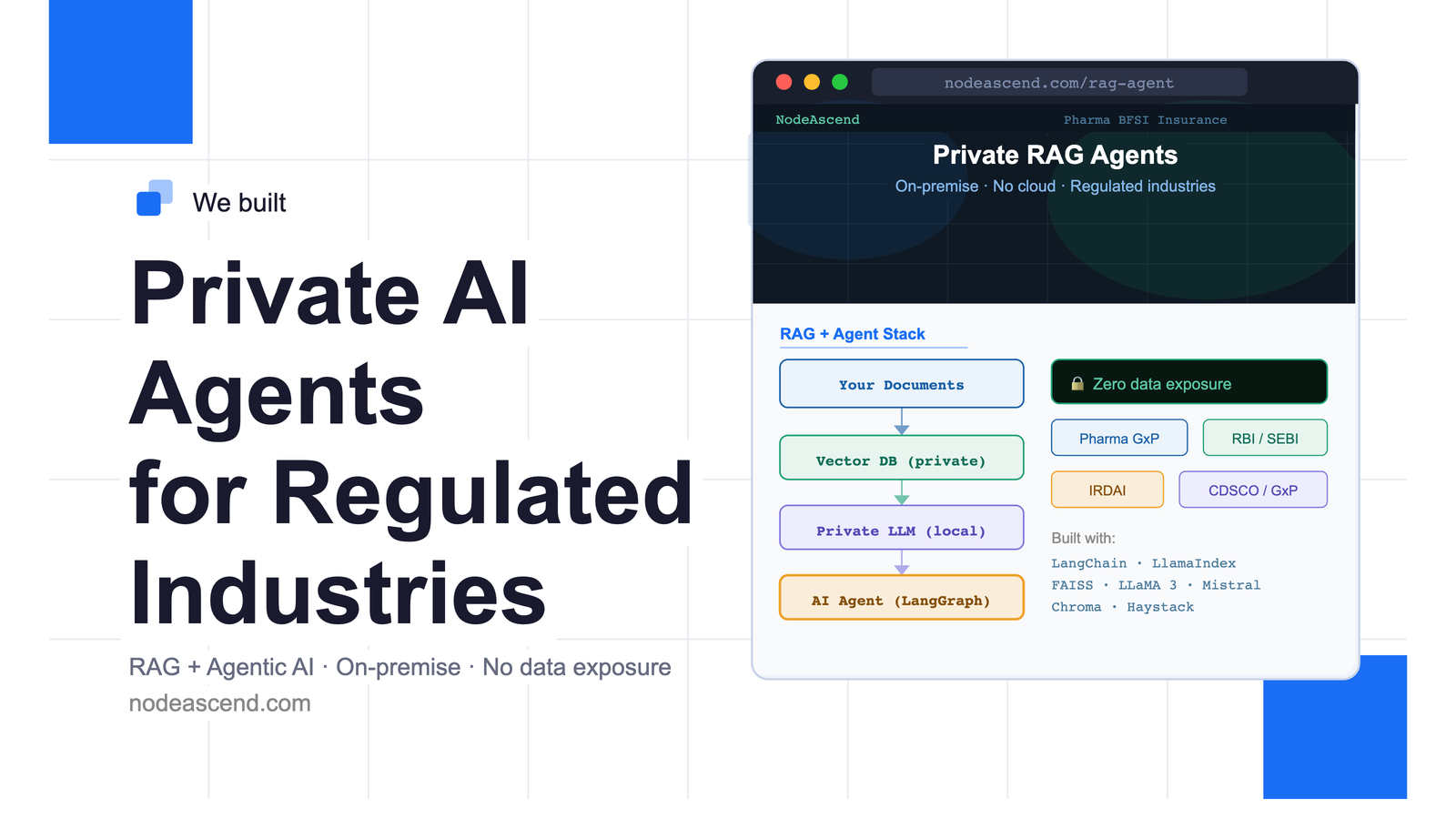
Where a wrong answer has legal or financial consequences, data usually cannot leave your infrastructure. That shapes the build: private RAG, a locally hosted model, cited answers and a person at every consequential decision. Here is how that looks in four sectors.
Compliance answers in minutes, not hours
A question that crosses CDSCO guidance, ICH requirements and internal SOPs is answered with all three cited. The same agent can review batch records for deviations and draft pre-filled regulatory responses, all on-premise and logged for Schedule M and 21 CFR Part 11 data-integrity needs.
Every credit policy clause in one place
Underwriters ask any question about current credit policy and get the exact clause back. The agent also flags when a proposed deal structure conflicts with the product programme, before it reaches committee. Data stays within RBI localisation rules.
Claims cross-checked against the policy
The agent compares a claim with policy wording, endorsements, exclusions, IRDAI guidelines and past decisions, surfaces contradictions and drafts the first assessment with citations. The analyst makes the call.
New circulars mapped to your policies daily
RBI, SEBI and IRDAI updates are read as they arrive, matched to the internal policies they affect, and turned into a prioritised action list each morning, so a monthly scramble becomes a short daily review.
The stack, layer by layer
We choose tools for your data, hosting rules and workflow, not the other way round. These are the options we pick from in each layer, with the question that decides between them.
- LangChain
- LangGraph
- CrewAI
- AutoGen
- LlamaIndex
Stateful multi-step work suits LangGraph; document-heavy retrieval suits LlamaIndex; role-based teams of agents suit CrewAI or AutoGen.
- OpenAI GPT
- Anthropic Claude
- Google Gemini
- Llama
- DeepSeek
- Mistral
Hosted models where data rules allow; open-source models run on your own hardware where they do not.
- Pinecone
- Weaviate
- Milvus
- Chroma
- Qdrant
- PostgreSQL
- Snowflake
- Databricks
Managed vector stores for speed to launch; self-hosted Chroma, Qdrant or pgvector when documents must stay inside.
- Python
- FastAPI
- TypeScript
- Node.js
- AWS
- Azure
- Google Cloud
We deploy where your systems already live, so access control and billing stay with the accounts you own.
For documents we use parsers such as Unstructured and Apache Tika, with OCR for scanned records. Embeddings such as BGE-M3 run locally when nothing may leave your servers.
Guardrails and LLMOps: how agents stay safe to run
In a well-built agent, a hallucination becomes a design problem you can control rather than a model quirk you hope away. These are the controls we put in before go-live.
- Citation enforcement. No source, no answer. The agent says it does not know.
- Confidence thresholds. Weak retrieval routes the case to a person instead of generating.
- Contradiction flags. When an old and a new policy disagree, both are shown and the conflict is raised.
- Human approval gates. Anything touching money, customers or filings waits for sign-off.
- Execution tracing. Every retrieval, tool call and output is logged with time, user and source.
- Least-privilege access. Each tool gets the narrowest permission its task needs, with PII masked.
- Evaluation on a schedule. RAGAS and DeepEval test sets run after launch, because accuracy drifts as documents grow.
- Cost tracking. Token spend per workflow is measured, so the model is sized to the job.
How an AI agent project runs
We build something working early, put it in front of the people who will use it and improve it from their feedback.
Discovery
We map the workflow and its documents, pick the single highest-value starting point, define what "accurate" means for your domain and build a test set to measure against.
Proof of concept
A representative sample is indexed, the agent is connected to one or two systems, and accuracy is measured against the test set before any major infrastructure commitment.
Production build
Full ingestion, orchestration, integrations with systems such as LIMS, ERP or document management, role-based access, audit logging, load testing and user training.
Run and improve
Automatic re-indexing as documents change, accuracy and cost tracking, and new capabilities as further use cases are confirmed.
What drives the cost of AI agent development
Two agents with the same headline can differ several times in price. These are the factors that decide it, and how to keep each one in check.
| Cost factor | Why it moves the price | How to keep it down |
|---|---|---|
| Workflow depth | More steps and branches mean more logic, testing and failure handling | Start with one workflow and its main path |
| Number of integrations | Each system adds permissions, field mapping and error states | Connect the two systems that matter most first |
| Data readiness | Messy, scanned or unstructured documents need cleaning before retrieval works | Fix document hygiene on the starting sample |
| Hosting model | Self-hosted models need hardware sizing and ongoing upkeep | Use hosted models where data rules allow |
| Approval and compliance rules | Audit trails, approval gates and controls add build and test time | Agree which actions need sign-off up front |
| Running cost | Model tokens and infrastructure are paid every month | Measure tokens per case and right-size the model |
Our free automation audit ends with a written build cost range for each workflow worth automating, so you can compare it with what the work costs today.
When an AI agent is the wrong answer
Low-quality documents. If records are heavily scanned, inconsistent and carry no metadata, retrieval will disappoint until the document problem is fixed. We say so before taking the project.
A short, stable FAQ. Twenty questions with fixed answers do not need an agent. A simpler build is cheaper and easier to maintain.
Unreviewed high-stakes decisions. We will not ship an agent that makes consequential decisions with no human gate until an accuracy baseline has been measured together.
Start with one workflow
Tell us the task your team repeats every day, the systems it touches and who signs it off. We will tell you whether an agent is the right fit, how long a working prototype would take and what it would cost to find out. See the full scope on our AI agent development and automation services page, read the AI chatbot development guide for India if you are comparing simpler options, or talk to an engineer.
Frequently Asked Questions
What is the difference between an AI agent and a RAG system?
A RAG system answers a question from your documents and cites the source. An AI agent completes a task: it can use RAG to look something up, then check a database, update a record, draft a document and send it for approval. Most business agents use RAG as one of their tools.
How long does it take to build an AI agent?
A narrow agent working on your own data can usually be shown in days. A production agent takes longer because integrations, permissions, approval gates, monitoring and testing against real cases are built first. Regulated, document-heavy builds typically run through discovery, a proof of concept and a production phase over a few months.
Can an AI agent run on our own servers?
Yes. Open-source models such as Llama, Mistral or DeepSeek can run on your hardware or private cloud, with a self-hosted vector database and no calls to an outside model provider. We size the model to what your servers can run reliably and measure accuracy before go-live.
What should we prepare before starting an AI agent project?
Pick one workflow and write down its trigger, the systems it touches, the decisions in it and who approves them today. Gather a sample of real cases with the correct outcome, and name the person who owns the result. That is enough to scope a first agent and measure it.